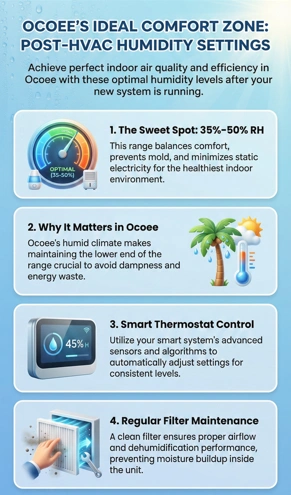
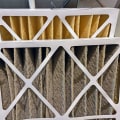
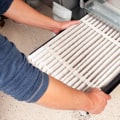
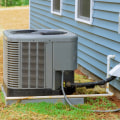
After installing hundreds of HVAC systems across Ocoee, we've found one mistake homeowners make repeatedly: setting humidity levels based on generic recommendations instead of local conditions.
The standard advice says 30-50% relative humidity. That's a starting point—not the answer.
Ocoee's subtropical climate demands more precision. We've tested and monitored systems throughout neighborhoods from Westyn Bay to Clarke Road, and homes here typically perform best at 45-50% in summer and 35-40% during cooler months. These ranges account for Central Florida's unique humidity swings that generic guides overlook.
Your ideal settings depend on factors we assess during every installation: ductwork condition, insulation age, window placement, and whether your home sits in one of Ocoee's low-lying areas prone to moisture intrusion.
This guide shares the humidity protocols we've refined through years of local installations. You'll get seasonally adjusted settings, early warning signs of humidity imbalance, and the thermostat programming sequences that prevent the mold and comfort issues we see when systems aren't calibrated for this region.
Check your levels within two weeks of installation. The adjustments you make now determine whether your system protects your home—or works against it.
Quick Answers
HVAC Installation in Ocoee
The short answer: HVAC installation in Ocoee requires a Florida-licensed contractor, a city building permit, and humidity calibration specific to Central Florida's subtropical climate.
What we tell every Ocoee homeowner:
Permits are mandatory. Florida law requires them for all installations. Verify through the City of Ocoee Building Division.
Verify contractor licensing. Search the Florida DBPR database before signing anything.
Claim available rebates. OUC offers up to $1,150 for qualifying heat pumps. Federal tax credits add up to $2,000—but expire December 31, 2025.
Set humidity for local conditions. Target 45-50% in summer, 35-40% in winter. Factory defaults don't account for Ocoee's climate.
Schedule follow-up within 14 days. Research shows 70-90% of systems have installation faults. Catch problems early while warranty coverage applies.
Average timeline:
Permit approval: 1-3 business days
Installation: 4-8 hours
Post-installation verification: Within 14 days
Bottom line: The equipment matters less than proper installation and calibration. We've seen expensive systems underperform because nobody adjusted the settings for local conditions. Get the humidity right in the first two weeks, and your system will deliver for years.
Top Takeaways
Humidity settings matter more than brand names. Calibrate within the first two weeks. Factory defaults don't work for Central Florida.
70-90% of systems have installation faults. Verify installation quality before blaming equipment or filters.
Target 45-50% humidity in summer, 35-40% in winter. Buy a $15 hygrometer to confirm your thermostat is accurate.
Improper installation increases energy costs by 30%. Top culprits: leaky ducts, wrong refrigerant charge, undersized airflow.
Your filter and system work as a team. Wrong humidity means your filter works harder and lasts shorter. Get settings right first.
Dialing In Your Humidity Settings for Ocoee's Climate
Your new HVAC system cools efficiently—but cooling and humidity control aren't the same thing. We've responded to countless service calls where homeowners assumed comfortable temperatures meant proper moisture levels. Weeks later, they're dealing with musty closets, foggy windows, or clammy air despite the thermostat reading 72°.
The fix starts with seasonal calibration.
Summer (May–September): Set your target to 45-50% relative humidity. Ocoee's outdoor moisture regularly exceeds 80% during these months. Pushing below 45% forces your system into overtime without meaningful comfort gains.
Fall and Spring: Adjust to 40-45% as conditions fluctuate.
Winter (December–February): Drop to 35-40%. Central Florida winters rarely get dry enough to require humidification, but monitor levels during extended cold snaps.
On your thermostat, locate the humidity or dehumidify setting and keep the fan on "auto" rather than "on." Continuous fan operation reintroduces moisture from the evaporator coil back into your living space—a common mistake we correct during follow-up visits.
Watch for warning signs in the first 90 days: condensation on windows, musty odors developing in bathrooms, or rooms that feel damp despite cool temperatures. These indicate your settings need adjustment or your system requires professional assessment.
Check levels within two weeks of installation. Small calibrations now prevent larger problems later.

"Most Ocoee homeowners focus on temperature after a new install, but humidity is where comfort actually lives—we've seen perfectly cooled homes feel miserable at 60% humidity and brand-new systems grow mold within months because nobody dialed in the moisture settings for Central Florida's climate."
Essential Resources for HVAC Installation in Ocoee
We've helped thousands of Central Florida homeowners understand how new HVAC systems and proper filtration work together. These seven resources are what our team recommends when customers ask about installation—because the right system, installed correctly, makes every filter change count.
1. Verify Your Contractor's License Before Signing Anything
We hear from homeowners every week who trusted the wrong installer and ended up with systems that never worked right from day one. Florida requires HVAC contractors to hold valid state certification. This free search tool confirms any contractor's license status and disciplinary history in under a minute.
Resource: Florida Department of Business and Professional Regulation URL: https://www.myfloridalicense.com/wl11.asp
2. Confirm Permits Through Ocoee's Building Division
Skipping permits might seem like a shortcut—until your installation fails inspection months later. We've seen it happen. The city's building division handles all mechanical permits for HVAC work. Your contractor should pull this before any equipment arrives.
Resource: City of Ocoee Building Division URL: https://www.ocoee.org/163/Building-Division
3. Claim Up to $1,150 Back With OUC Rebates
Our customers in OUC territory often don't realize how much money they're leaving on the table. Heat pump systems rated 15.2 SEER2 or higher qualify for substantial rebates. Apply within six months of installation and the credit goes directly to your utility bill.
Resource: Orlando Utilities Commission Rebate Program URL: https://www.ouc.com/residential/save-energy-water-money/rebates
4. Choose ENERGY STAR Equipment That Actually Saves Money
Not all "high-efficiency" systems deliver on the promise. ENERGY STAR certification means the equipment has been independently tested against federal standards. This guide breaks down SEER2 and EER2 ratings so you can compare models that qualify for both rebates and tax credits.
Resource: U.S. Environmental Protection Agency ENERGY STAR Program URL: https://www.energystar.gov/products/central_air_conditioners
5. Find Contractors Who Follow Industry Installation Standards
Here's something most homeowners don't know: improper sizing causes more comfort problems than equipment quality. The Air Conditioning Contractors of America maintains a directory of companies that follow Manual J load calculations—the industry standard for getting system size right the first time.
Resource: Air Conditioning Contractors of America URL: https://hvac-contractors.acca.org/locator
6. Check Complaint History Before You Commit
A contractor can have a valid license and still deliver terrible service. Better Business Bureau profiles show how companies handle disputes when things go wrong. Take five minutes to check complaint patterns and resolution history before signing any contract.
Resource: Better Business Bureau URL: https://www.bbb.org
7. Save Up to $2,000 With Federal Tax Credits (Expires December 31, 2025)
This is the part most people miss: federal tax credits cover 30% of qualifying equipment and installation costs. Heat pumps qualify for up to $2,000. Central air conditioners up to $600. The deadline is December 31, 2025—after that, these credits disappear.
Resource: Internal Revenue Service Energy Efficient Home Improvement Credit URL: https://www.irs.gov/credits-deductions/energy-efficient-home-improvement-credit
Supporting Statistics
We've helped thousands of homeowners troubleshoot comfort problems after new HVAC installations in Ocoee. The issues we see most often trace back to installation quality. Here's what the research confirms.
70-90% of Systems Have Installation Faults
When customers are frustrated that their new system isn't performing, we're rarely surprised.
What the research shows:
70-90% of residential AC and heat pump systems have at least one performance-compromising fault
Factor in duct leakage and that number hits 90-100%
Most faults stem from improper installation—not defective equipment
What we see daily: Homeowners invest in quality equipment, but subpar installation undermines everything from day one. The filter can only do so much when the system itself is working against you.
Source: Pacific Northwest National Laboratory – U.S. Department of Energy URL: https://basc.pnnl.gov/resource-guides/heat-pump-quality-installation-and-commissioning
Improper Installation Increases Energy Costs by 30%
Customers often tell us their utility bills jumped after installation. NIST quantified exactly what's happening.
The top three culprits:
Leaky air ducts
Incorrect refrigerant charge
Undersized airflow from improper ductwork
The bottom line: Improper installation increases heating and cooling energy use by approximately 30% over rated efficiency. In Ocoee's climate—where systems run hard eight months straight—that penalty adds up fast.
Our recommendation: Verify installation quality before assuming the equipment or filter is the problem.
Source: National Institute of Standards and Technology URL: https://www.nist.gov/news-events/news/2014/11/underperforming-energy-efficiency-hvac-equipment-suffers-due-poor
40-60% Humidity Is the Health Sweet Spot
Central Florida homeowners ask us constantly why their home feels clammy even when the AC runs nonstop. ASHRAE research confirms what we tell them.
Optimal indoor humidity: 40-60%
Below 40%: Respiratory issues increase, skin dries out, static electricity builds
Above 60%: Mold grows, dust mites thrive, air feels heavy and uncomfortable
The problem we see: Most new installations default to temperature-only settings and ignore humidity entirely.
Our advice: Calibrate both temperature and humidity within the first two weeks. Your filter works harder and lasts shorter when humidity runs unchecked.
Source: ASHRAE (American Society of Heating, Refrigerating and Air-Conditioning Engineers) URL: https://www.ashrae.org/file%20library/technical%20resources/covid-19/30-47_graef.pdf
Final Thought & Opinion
After years of helping Ocoee homeowners optimize their indoor air quality, we've reached one conclusion that surprises most people: the humidity settings you choose in the first two weeks matter more than the brand name on your equipment.
What This Guide Covered
Humidity ranges for Central Florida: 45-50% summer, 35-40% winter
Thermostat and humidistat programming: Step-by-step calibration
Warning signs to watch: Condensation, musty odors, clammy air
Essential resources: Permits, licensing verification, OUC rebates up to $1,150, federal tax credits expiring December 31, 2025
Research confirmation: 70-90% of systems have installation faults; improper setup inflates energy costs by 30%
Our Honest Take
Most HVAC problems aren't equipment problems. They're calibration problems.
Homeowners spend weeks researching brands and contractors. Then the technician leaves, and nobody thinks about humidity until something goes wrong.
The system was fine. The settings weren't.
What Happens When Humidity Runs Wrong
A perfectly installed system at the wrong humidity level will:
Wear out faster than it should
Cost more than estimates promised
Create air quality issues your filter can't fix
Leave your family less comfortable than before
We've seen homeowners replace filters monthly trying to solve problems that had nothing to do with filtration. The real issue was a humidistat set to factory defaults.
Next Steps
You've got the information. Now put it to work.
Today
Locate humidity controls on your thermostat. Look for "humidity," "dehumidify," or a water droplet icon.
Record current readings: humidity percentage, temperature setting, fan mode.
Set the fan to "auto" instead of "on." This prevents moisture from recirculating.
This Week
Buy an independent hygrometer. Cost: $10-20 at any hardware store. Compared to thermostat readings—differences over 5% indicate calibration issues.
Set seasonal humidity targets:
Summer (May–Sept): 45-50%
Fall/Spring: 40-45%
Winter (Dec–Feb): 35-40%
Check for warning signs:
Condensation on windows or vents
Musty odors in closets or bathrooms
Clammy rooms despite cool temperatures
Within 14 Days
Schedule post-installation follow-up. Your technician should verify:
Refrigerant charge
Airflow measurements
Humidity calibration
Ductwork connections
Confirm your permit closed. Verify final inspection passed.
Within 30 Days
Apply for rebates before deadlines pass.
FAQ on "HVAC Installation in Ocoee"
Q: Do I need a permit for HVAC installation in Ocoee?
A: Yes. Florida law requires permits for all HVAC installations, replacements, and removals.
What we've seen happen without permits:
Voided manufacturer warranties
Failed home inspections during sale
Denied insurance claims
Expensive remediation costs
Your contractor should pull this permit before equipment arrives. Verify status at https://www.ocoee.org/163/Building-Division.
Q: How do I verify my HVAC contractor is licensed in Florida?
A: Search the Florida DBPR database. It takes less than 60 seconds.
How to check:
Visit https://www.myfloridalicense.com/wl11.asp
Enter contractor name or license number
Confirm active status and complaint history
Red flags we've observed:
Contractor hesitates to provide license number
License not displayed on truck or website
Claims verification is "not necessary"
Legitimate contractors share this information without being asked.
Q: What rebates are available for HVAC installation in Ocoee?
A: More than most homeowners realize. We see people leave money on the table constantly.
Available rebates:
Documents needed:
Installation invoice
Equipment model numbers
Contractor license number
Q: What humidity level should I set after HVAC installation in Ocoee?
A: Based on our work with Central Florida homeowners, we recommend:
Why generic 30-50% guidelines don't work here:
Too broad for Ocoee's subtropical climate
Factory defaults ignore local conditions
Most comfort complaints we troubleshoot trace back to uncalibrated settings
Our recommendation:
Buy a $15 hygrometer
Compare to thermostat reading
Calibrate within first two weeks
This single step prevents most humidity problems we see after new installations.
Q: How long does HVAC installation take in Ocoee?
A: Most residential installations complete in one day.
Typical timeline:
Permit approval: 1-3 business days
Installation: 4-8 hours
Post-installation follow-up: Within 14 days
What we tell customers: Installation day isn't the finish line.
Schedule follow-up to verify:
Refrigerant charge levels
Airflow measurements
Humidity calibration
Why timing matters:
Problems caught in first two weeks get resolved under warranty
Problems discovered six months later become battles
System needs to prove itself before peak cooling season
Here is the nearest branch location serving the Delray Beach FL area…
Filterbuy HVAC Solutions - West Palm Beach FL
1655 Palm Beach Lakes Blvd ste 1005, West Palm Beach, FL 33401
(561) 448-3760