15x15x4 Air Filters: Quiet Wins for Studio Apartments
In a 400-square-foot studio, your HVAC closet is usually six feet from your bed. So when the blower works overtime against a too-thin filter, you hear it every night. The fix most studio renters never get told about: a 15x15x4 air filter. Deeper pleats mean less strain on a compact air handler, which means a noticeably softer hum. After thirteen years of making filters in the USA, the studio's quiet-down is one of those small upgrades that customers keep writing us about.
TL;DR Quick Answers
15x15x4 Air Filters
A 15x15x4 is a high-capacity HVAC filter measuring 15 inches wide, 15 inches tall, and 4 inches deep. The 4-inch depth is what matters most. More pleat surface lets the blower push air through with less resistance, which means quieter operation, cleaner air, and longer filter life. The fast facts before you order:
Actual size runs about 14.5 x 14.5 x 3.625 inches. Filters ship a half inch under nominal, so they slide into the cabinet without forcing.
Lifespan is 6 to 12 months in a typical studio, roughly four times what a 1-inch can deliver.
MERV 11 is the sweet spot for most studios. MERV 13 is the right call for allergy, asthma, or smoke concerns.
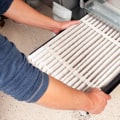
Your HVAC cabinet has to be 4 inches deep for this filter to fit. Pull your current filter and check the third number on the label before you buy.
Top 5 Takeaways
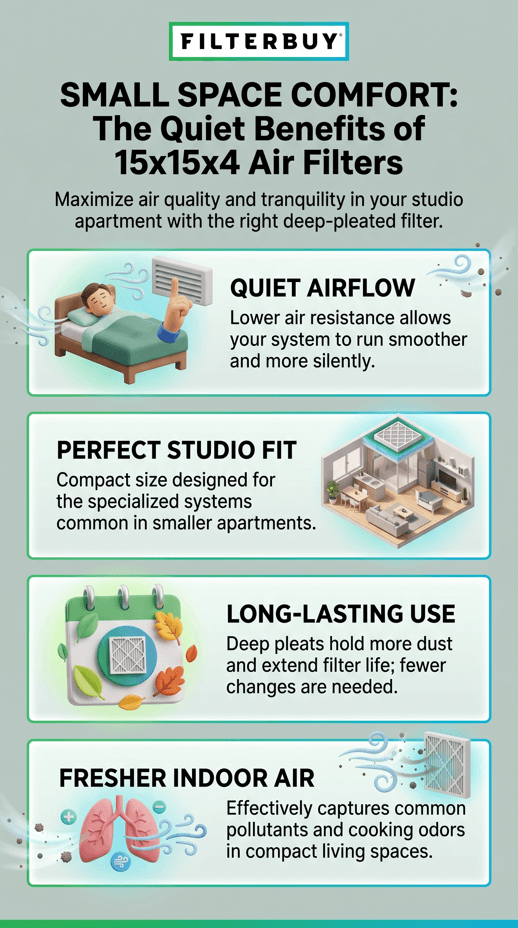
A 4-inch filter is audibly quieter than a 1-inch filter in a small space. More pleat surface area means less blower strain, and a less-strained blower makes a softer sound every minute it runs.
15x15x4 is an oddball size, so confirm your cabinet depth before ordering. Actual dimensions run about a half inch under what the label says.
For most studios, MERV 11 wins. Step up to MERV 13 if allergies, asthma, or wildfire smoke are in the picture.
A 4-pack typically covers about two years of filter changes for a single studio. Auto-delivery handles the rest.
Higher-MERV pleated filters also extend the life of compact apartment HVAC, which is less forgiving of restricted airflow than a full-sized home system.
Why A 4-Inch Filter Beats A 1-Inch One In A Studio
A 1-inch filter has to do all its work in a single thin sheet of media. The blower pushes air through that sheet, fights the resistance, and works harder for every cubic foot. A 4-inch filter unfolds across roughly four times the pleat surface, so the same air slips through with much less effort. The blower softens, the system runs cooler, and the electric bill notices.
In a studio, that math hits harder than it does in a 3,000-square-foot house. The HVAC closet is usually a few steps from where you sleep, so any drop in blower noise is felt directly. A smaller indoor air volume means cooking smoke, pet dander, and off-gassing furniture concentrate faster, so a higher-capacity filter has more to do. And apartment HVAC tends to be more sensitive to pressure drop than full-size residential equipment, so the wrong filter wears it out faster.
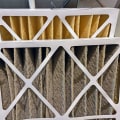
A 4-inch filter, essentially a deeper-pleat version of the standard pleated air filter you'd recognize from any hardware store, handles all three. The blower runs softer, particle capture improves, and the filter lasts roughly four times as long as a 1-inch filter.
Worth saying clearly before you buy: the 4-inch only fits if your HVAC has a 4-inch cabinet. You can't swap a 1-inch slot for a 4-inch filter unless the slot was built for it.
What MERV Rating Is Right For Studio Living
MERV stands for Minimum Efficiency Reporting Value, the scoring system that tells you how small a particle a filter can catch. Higher number, smaller particles caught.
In a studio, the choice usually comes down to MERV 11. Here is how the three common ratings line up:
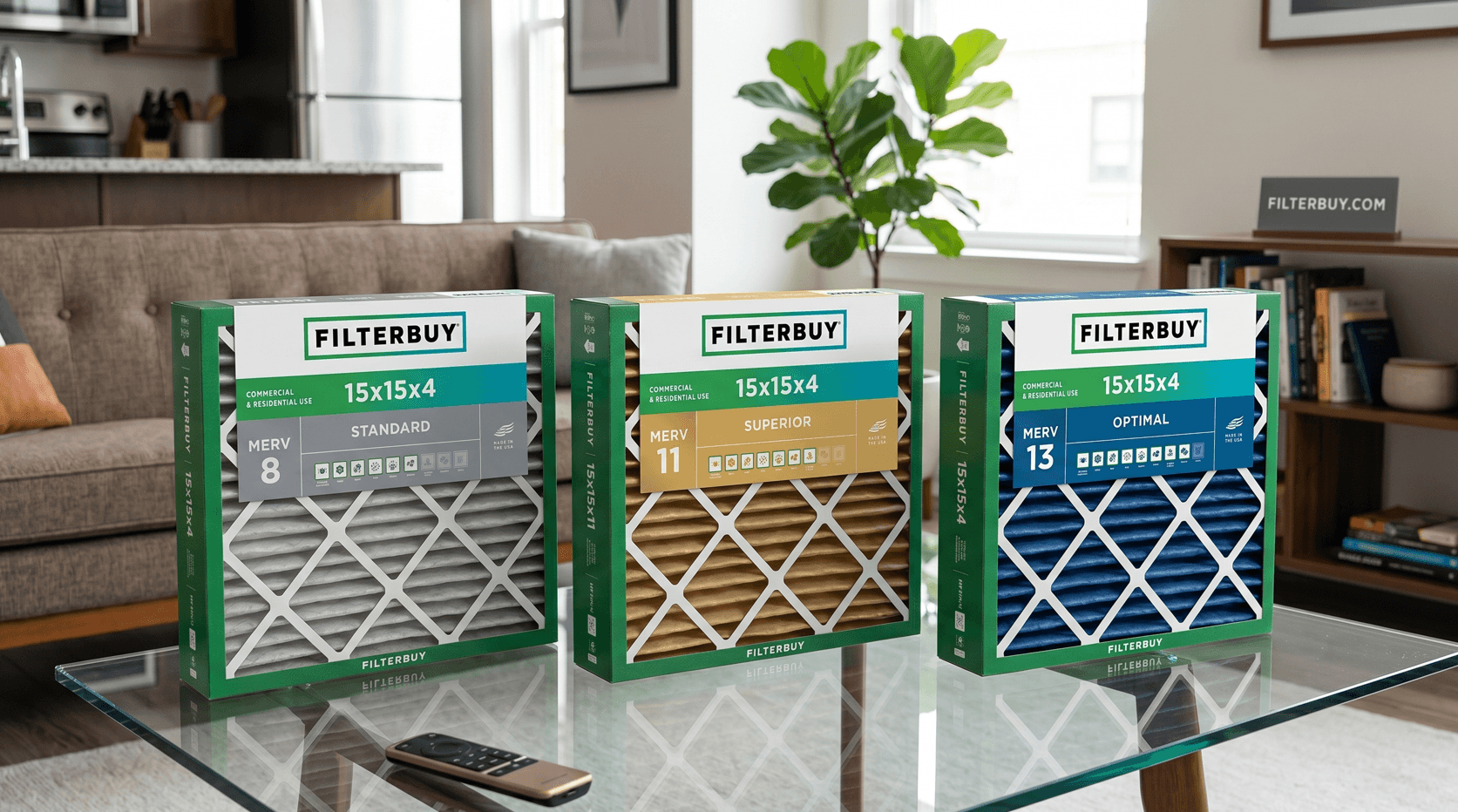
MERV 8 catches dust, pollen, and lint. Fine for a clean building with no pets and no health concerns.
MERV 11 adds pet dander, smog particles, and finer dust. The best balance of capture and airflow for most studios.
MERV 13 adds smoke particles, bacteria, and virus carriers. Worth the small extra cost if anyone in the home has allergies, asthma, or lives where wildfire smoke is a fact of life.
The honest answer to "Will MERV 13 strain my HVAC?" is sometimes, usually with older or undersized systems. Most modern equipment handles MERV 13 without issue, but it's worth five minutes with the manufacturer's manual before upgrading. If you want a deeper look at filter types and how to match them to a new system, we wrote a companion guide on what type of filter you should use with a new HVAC system.
For studios without specific health concerns, MERV 11 is the answer. For wildfire country, a freeway view, or a four-legged roommate, go MERV 13.
Where To Buy A 15x15x4 And How Often To Change It
15x15x4 isn't a bestseller, so you'll rarely find it sitting on a Home Depot shelf. Most readers have better luck in three ways:
Online specialists keep 15x15x4 in stock in MERV 8, 11, and 13, usually with auto-delivery as a standard option. At Filterbuy, the size is one of about 600 we make in the USA.
Big-box retailers can special-order, but the lead time is usually longer than placing the same order online.
Custom-cut shops handle off-spec dimensions when your cabinet is something like 14.75 x 14.75 x 3.75, where a standard nominal size doesn't quite work.
For replacement frequency, the math depends on what's going on in your studio:
Every six months for MERV 8 or 11 in a typical pet-free studio with average use.
Every three to four months, if you have pets, cook heavily, smoke nearby, or run MERV 13 through a smoky season.
A 4-pack typically covers about two years of changes for a single studio, which works out to one delivery every 18 to 24 months.
One trick that's worth the thirty seconds it takes: photograph the filter the day you install it. Pull it out every three months and compare. Your eyes spot the blackening faster than any calendar can.
"After years of troubleshooting noisy HVAC in studio apartments and small condos, the most underrated fix is filter depth. Switching a reader from a 1-inch to a 15x15x4 doesn't just clean the air better; it audibly changes how the system sounds every minute it runs."
Essential Resources On 15x15x4 Air Filters
Once you've picked your filter, seven sources are worth bookmarking. Each one covers a different piece of the picture you may want next.
1. The EPA's Plain-Language Playbook On Home Filtration
The EPA's homeowner-facing guide spells out what HVAC filters do, what they don't, and how to pick one without falling for marketing. About a 10-minute read, and probably the cleanest summary of the topic anywhere on the web.
Source: EPA Guide To Air Cleaners In The Home
2. The Department Of Energy's Maintenance Checklist For Your AC
The DOE walks through the maintenance that keeps an air conditioner running smoother and longer. Filter replacement gets called out as the most important single task. If you only do one thing on the list, this is where to start.
Source: Department Of Energy Air Conditioner Maintenance Guide
3. What The CDC Recommends For Indoor Air Filtration At Home
The CDC's NIOSH ventilation guidance comes from decades of respiratory infection research, with the short version being to use MERV 13 if your HVAC can handle it. Helpful for cutting through internet noise on filter ratings.
Source: CDC NIOSH Ventilation And Respiratory Viruses
4. AAFA's Room-By-Room Guide To Controlling Indoor Allergens
The Asthma and Allergy Foundation of America covers dust mites, pet dander, pollen, and the rest, and frames air filtration as one piece of a larger picture rather than a magic fix.
Source: AAFA Guide To Controlling Indoor Allergens
5. Low-Cost Indoor Air Upgrades From The American Lung Association
The American Lung Association's practical checklist lists short-term and long-term steps you can take to improve indoor air, including a clear MERV-13 filter recommendation. Several of the suggestions are free.
Source: American Lung Association: Let The Air In
6. The Peer-Reviewed Case For Higher-MERV Filtering
An NIH-indexed study quantifies how MERV 12 and higher filters can cut indoor concentrations of cat dander, fine particulates, and respiratory viruses by more than 50%. Useful when you want the research backing the recommendation.
Source: NIH Research On MERV Filters And Asthma Triggers
7. ACAAI's Side-By-Side On Whole-House Versus Portable Air Cleaning
The American College of Allergy, Asthma, and Immunology lays out when a whole-house HVAC filter does the job, when a portable air cleaner is the better tool, and how the two work together in a small space.
Source: ACAAI Air Filter Treatment Guide
Supporting Statistics
Three data points from U.S. public health and housing authorities, each pointing to the case for paying attention to your indoor air.
1. Over 50% Of U.S. Homes Carry Six or More Detectable Indoor Allergens
The American Academy of Allergy, Asthma & Immunology documents that more than half of American homes contain six or more detectable indoor allergens, including dust mites, pet dander, mold, and cockroach debris. In a studio, where there are no doors to close between a kitchen and a bedroom, that concentration matters more.
Source: AAAAI Managing Indoor Allergen Culprits
2. HUD Recommends Replacing Air Filters Every 90 Days For A Healthier Home
The Department of Housing and Urban Development's Healthy Homes guidance lists 90-day air filter replacement as one of ten basics for a safer home, with more frequent changes recommended for households with pets. HUD links poor housing conditions to asthma, respiratory infections, and injury risk.
Source: HUD Healthy Homes 10 Tips Fact Sheet
3. ENERGY STAR Air Cleaners Use Over 50% Less Energy Than Standard Models
ENERGY STAR data shows certified room air cleaners run more than 50% more efficiently than standard models, saving roughly 211 kWh of electricity and between $18 and $40 a year. In a studio, where every kilowatt-hour lands on your bill, that adds up faster than it does in a larger home.
Source: ENERGY STAR Air Cleaners Buying Guidance
Final Thoughts And Opinion
If we had to pick one upgrade for a studio that doesn't involve hiring anyone or rearranging furniture, this is it. 15x15x4 pleated air filters are among the cheapest, quietest wins available in apartment living.
The honest opinion piece:
Most studio dwellers overspend on portable air purifiers and underspend on the actual HVAC filter. Get the filter right first, then add other tools if you still need them.
The "MERV 13 for everyone" advice is well-intentioned but isn't always free. For a small HVAC system, MERV 11 is usually the smarter call.
The 4-inch versus 1-inch question is settled. If your cabinet supports a 4-inch, sticking with a 1-inch leaves quiet, clean air, and energy savings on the table.
After thirteen years of shipping filters to families and renters across the country, the pattern in our customer email holds: people install a thicker filter, notice within a week that the system sounds different, and rarely go back.
Frequently Asked Questions
Q: Is A 15x15x4 Air Filter The Same As A 14.5x14.5x3.625?
A: Effectively yes. The 15x15x4 label is the nominal size, and 14.5x14.5x3.625 is the actual size. Filters ship a half inch under nominal, so they slide into the cabinet without forcing. Feature, not defect.
Q: Will A 4-Inch Filter Fit A Slot Designed For A 1-Inch Filter?
A: No. The cabinet has to physically be 4 inches deep. The fastest way to confirm: pull out your current filter and look at the printed dimensions. If the third number is a 1, you have a 1-inch slot, not a 4-inch one.
Q: Does A 15x15x4 Actually Reduce HVAC Noise?
A: Yes, indirectly. A thicker filter has more pleat surface area, which means less resistance for the blower to fight. A less-strained blower makes a softer sound. Most readers hear the change within a week of installing.
Q: What MERV Rating Works Best In A Small Space?
A: For most studios with no specific health concerns, MERV 11. Step up to MERV 13 if allergies, asthma, or urban smoke are factors, and confirm your HVAC supports it before you do.
Q: How Often Should I Change A 15x15x4 Filter In A Studio?
A: Every six months for MERV 8 or 11 in a typical pet-free studio. Every three to four months, if you have pets, smoke nearby, or run MERV 13 through a smoky season. Take a photo at install, compare quarterly, and trust your eyes more than the calendar.
Q: Can I Get A 15x15x4 In A 4-Pack?
A: Yes. Most online filter specialists offer 4-packs, and for an average stud, io that's about two years of filters per order. Set up auto-delivery, and the next one shows up before you need it.
Q: Are 15x15x4 Filters Available With Carbon For Odors?
A: Some are. If pet odors, cooking smells, or VOCs are part of your situation, look for a carbon-activated 15x15x4. Heads up: the carbon's odor-absorption capacity wears down faster than its particulate capture, so plan to change every three to six months to keep odor performance strong.
Q: Where Can I Buy A 15x15x4 Air Filter Near Me?
A: Because 15x15x4 isn't a top-selling size, it's rarely on big-box hardware store shelves. Online specialists carry it in stock with auto-delivery, and big-box stores can typically special-order. Online is usually faster.
Quiet Wins Start With The Right Filter
Swap your 1-inch for a 15x15x,4 and you'll likely hear the difference within a week. Confirm your cabinet depth, pick your MERV, set up auto-delivery, and your filter is off your mental list until next year.
Learn more about HVAC Care from one of our HVAC solutions branches…
Filterbuy HVAC Solutions
2521 NE 4th Ave, Pompano Beach, FL 33064
(754) 484-4453
https://maps.app.goo.gl/JmWkEXya7uzuLzBh8